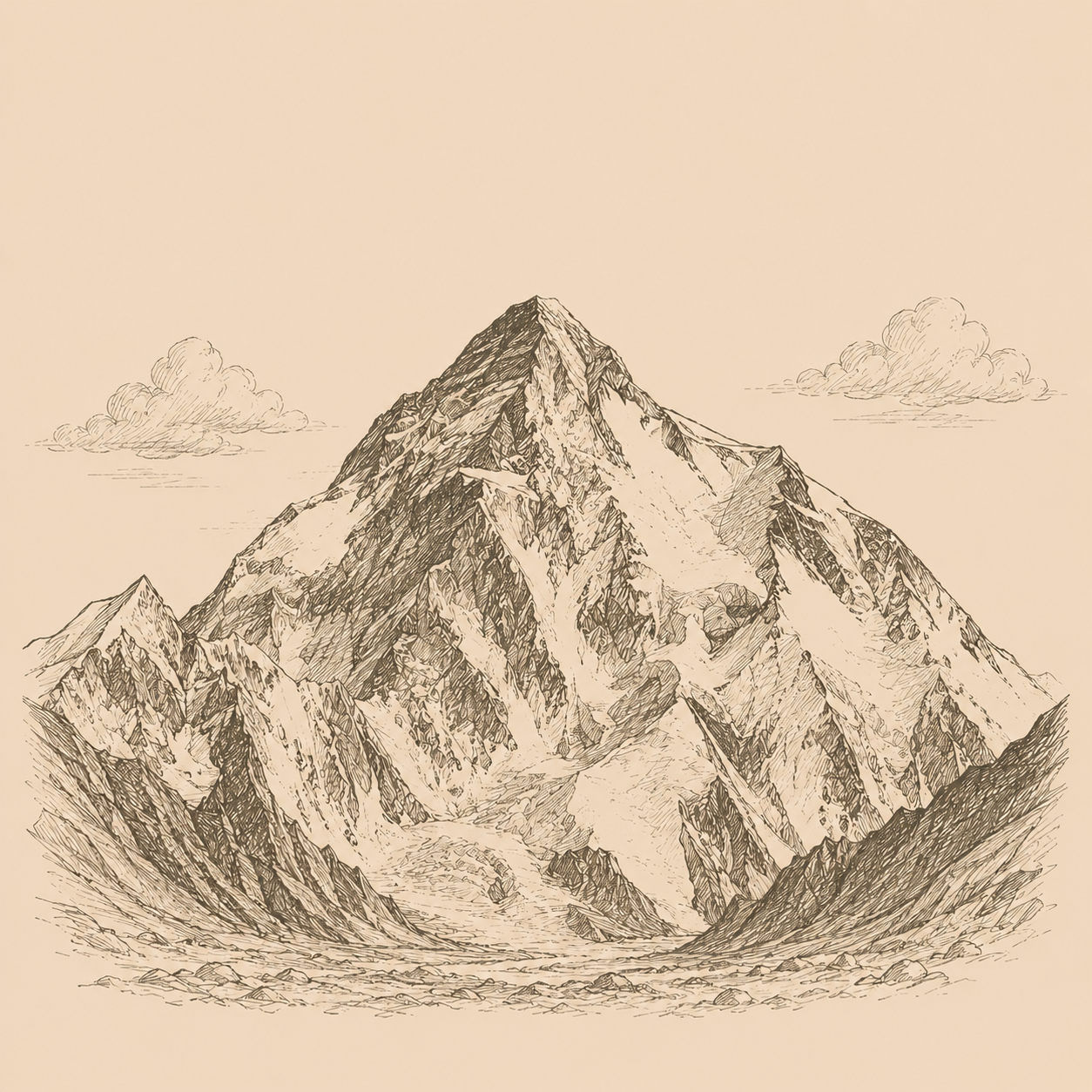
T here is a moment on a serious mountain when the summit stops being the point. You are too cold to think clearly, too tired to feel your fingers properly, the wind is doing something to the air that makes every breath feel like half a breath, and the voice in your head that usually argues for comfort has gone completely quiet. Not because it gave up. Because it finally understands that this is what you came for. Not the view from the top. Not the photograph. This — right here — this is the thing you travelled ten thousand kilometres to feel. We didn't summit K2. We were turned back at Camp 3, somewhere around 7,200 metres, by weather that made the decision for us in a way that felt less like defeat and more like the mountain being honest. And I would do every single day of it again without hesitating.
K2 Is Not Everest
People who haven't been to either sometimes treat them as interchangeable — two very tall mountains, both in Asia, both requiring serious commitment. This is like saying a swimming pool and the ocean are interchangeable because they both contain water.Everest is higher. K2 is harder. K2 has a summit success rate of roughly 25 to 30 percent. Its fatality rate is among the highest of any eight-thousander. It doesn't have the commercial infrastructure that Everest has built over decades. There are no fixed ropes on most of the route by default. The weather windows are shorter, less predictable, and more violent. And the mountain itself — the Abruzzi Spur, the Black Pyramid, the Bottleneck — is technically demanding in a way that altitude alone doesn't capture.
K2 doesn't reward ambition. It rewards patience, preparation, and the willingness to turn back — sometimes more than once.Mountaineers call it the Savage Mountain. That name was earned.
The Journey Before the Mountain
The approach to K2 base camp is itself a multi-day undertaking that would qualify as a serious expedition in most other contexts. You fly into Islamabad, then to Skardu, then you drive to Askole — a small village at the edge of the road network. From Askole it is roughly 100 kilometres on foot through the Karakoram to base camp at 5,150 metres. Four to six days of walking depending on your pace and the weather, through some of the most dramatic landscape on earth.The Baltoro Glacier alone — 63 kilometres of moving ice — is something that recalibrates your sense of scale permanently. You walk on it for days. It groans. It shifts. It is alive in the way that only very old, very large things are alive. Around you the Karakoram peaks rise on every side — Masherbrum, Gasherbrum, Broad Peak, and then eventually, at the head of the glacier, K2 itself appearing around a corner of rock like something that was always there and you just weren't ready to see it.
By the time you reach base camp you have already been changed by the journey. The summit hasn't even started yet.
What You Actually Need
Let's be practical for a moment, because adventure without preparation is just recklessness with better Instagram captions.Physical conditioning is the foundation and it cannot be faked. For a K2 attempt you need months of structured training — weighted pack carries, high altitude acclimatisation treks, cardiovascular base that is genuinely deep. Your body at 7,000 metres is operating on less than half the oxygen it gets at sea level. Every step costs more than it looks like it should. You need reserves you cannot imagine needing until you need them.
Layering is everything. The temperature range from base camp to high camps swings by 40 degrees or more. A proper layering system — moisture-wicking base, insulating mid layer, windproof and waterproof shell — is not optional equipment. It is the difference between discomfort and danger. At altitude, wet means cold, and cold at altitude can kill you faster than you expect.
Boots and crampons matter more than almost anything else. Frostbite begins in the extremities. Double or triple plastic boots rated to extreme altitude, fitted properly, with crampons that are dialled in before you ever touch the glacier.
Nutrition and hydration become a job you have to consciously perform. At altitude your appetite suppresses. Water freezes. Your body is burning through calories at a rate that is hard to keep up with. Eat when you're not hungry. Drink when you're not thirsty. Force both. This is unglamorous and essential.
Mental preparation is the thing nobody talks about enough. The long days of bad weather pinned in a tent at Camp 2 while the wind tries to remove the tent from the mountain. The decision to turn back when everything in you wants to keep going. The management of fear on technical terrain where a mistake has consequences. None of this can be trained for entirely in advance. But you can go in knowing it's coming.
Camp 3 and the Turn
We had a weather window. A narrow one — our guide said two days, maybe three. We moved from base camp to Camp 1 to Camp 2 in good time, acclimatisation holding, the team moving well. Camp 3 at 7,200 metres was the high point. We arrived in the afternoon, ate what we could manage, tried to sleep at altitude in the way you try to sleep at altitude — badly, shallowly, aware of every breath.The weather came in at midnight. Not gradually. All at once, the way K2 weather moves. Wind that made the tent fabric sound like it was being beaten. Snow horizontal. By 3am the decision had already been made by the mountain, even if we spent another hour pretending we were the ones making it.
The mountain was still there in the morning, exactly where it had always been, completely indifferent to what we wanted from it. That indifference is the whole lesson.We descended in deteriorating visibility, roped together, moving carefully. Base camp felt like a different planet — warmer, lower, oxygen-rich in a way you only notice after being without it. I ate three full meals that afternoon and slept for eleven hours.
What Almost Summiting Gives You
There is a version of this story that treats the turn-back as failure. I don't believe in that version.What K2 gave me in the approach, the acclimatisation, the camps, the one night at 7,200 metres, and the descent — that is a complete experience. The summit would have added a view and a photograph. It would not have added the thing that actually mattered, which was the sustained encounter with a place and a difficulty that showed me something true about my own limits and capacities.
Adventure at this scale is not about conquering anything. The mountain is not conquered. The mountain doesn't notice. What changes is you — slowly, over days of hard walking and thin air and small decisions that accumulate into something you carry home and can't quite explain to people who weren't there.
You come back different. Not dramatically different. Not visibly different to most people. But you know something now that you didn't know before, and no photograph captures it, and that's fine.
That's the whole point of going.