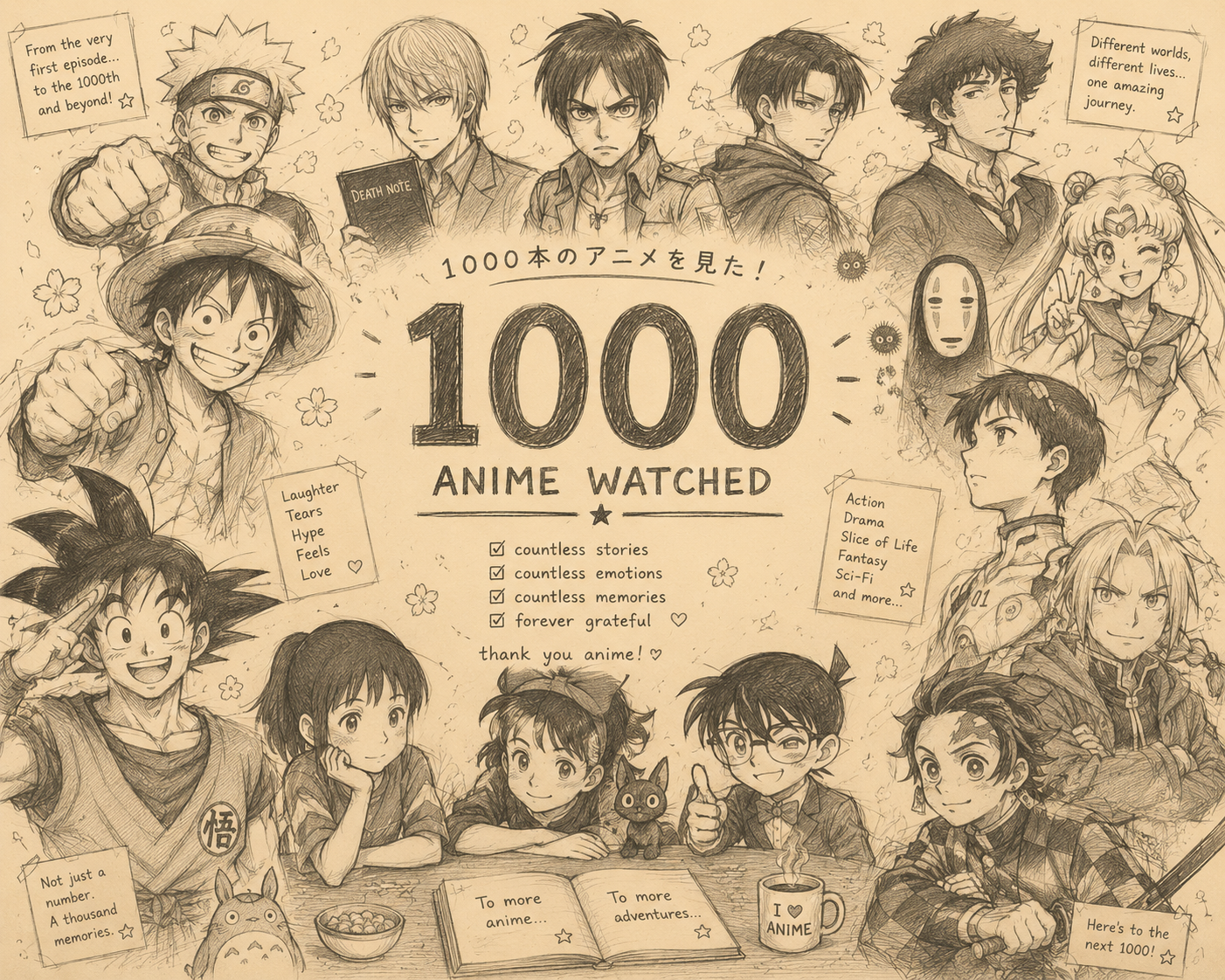
I have watched over a thousand anime. Not skimmed, not dropped at episode two, not left on the backlog forever — watched. Completed. Sat with. I have watched slice of life shows where nothing happens and cried anyway. I have watched mecha anime I didn't understand and felt something shift in my chest. I have watched sports anime about volleyball and ping pong and cycling and come out the other side genuinely believing that the human will to compete is one of the most beautiful things alive. I've done horror, isekai, shounen, seinen, josei, historical, psychological, romance, military, music, cooking. All of it. And I still don't know how to explain what anime is to someone who hasn't felt it yet.
It Is Not Escapism. Stop Calling It That.
People hear "anime" and picture a teenager hiding from the world in a dark room. And sure, that happens. But that framing misses the point entirely. Every great piece of fiction — every novel, every film, every song — offers an exit from the ordinary. Nobody calls reading Dostoevsky at 2am escapism. Nobody says a person is running from their problems because they cried at a film.Anime isn't a door you walk through to avoid the world. It's a world you walk into and choose to stay in.The difference matters. Escapism implies running away from something. Anime at its best is running toward something — toward beauty, toward grief, toward questions you didn't know you had. Toward worlds that are stranger and more honest than the one you live in.
What It Actually Takes to Make 12 Episodes
Here's what most people don't think about: a 12 episode anime season represents years of work compressed into roughly five hours of screen time. The source material — usually a manga or light novel — has to be adapted, cut, restructured. A team of directors, animators, storyboard artists, voice actors, composers, and sound designers work in a pipeline that is brutal even by entertainment industry standards.Key animators — the people who draw the important frames — are some of the most underpaid and overworked artists in any medium. A single sakuga sequence, the kind that makes you pause and rewind three times, might take one animator weeks. The music has to be scored to match cuts that are still being drawn. Voice actors record lines before animation is finished, working from rough storyboards, trying to give life to something that doesn't fully exist yet.
And then it airs. Twelve weeks. One episode at a time. And people watch it in twelve hours and say it was too short.
When you know this, you watch differently. Every frame starts to mean something. You notice the shortcuts and you notice the moments where someone clearly refused to take them.
The Genres Nobody Talks About
Everyone knows Naruto and Dragon Ball. Fewer people have seen Mushishi — a quiet, meditative series about a man who travels through rural Japan treating people afflicted by supernatural organisms. No fights. No tournament arcs. Just fog and folklore and a kind of stillness that is almost impossible to find anywhere else in fiction.Fewer still have seen Shouwa Genroku Rakugo Shinjuu — an anime about a dying form of Japanese oral storytelling, two men who loved the same art and couldn't save each other, and what it means to carry a tradition forward when you're not sure you deserve to. It is one of the greatest character studies I have encountered in any medium. It is also a 25 episode anime about rakugo performers that nobody outside the fandom talks about.
This is what 1000 anime gets you. Not just the landmarks but the quiet masterpieces that exist in the gaps between them.
The Nostalgia Is Unlike Anything Else
There is a specific feeling that comes from rewatching something you first saw as a child or a teenager. The opening theme plays and something in your body remembers before your brain does. It's not just nostalgia — it's something more physical than that. A warmth that starts in your chest and moves outward.The opening theme plays and something in your body remembers before your brain does.I rewatched Fullmetal Alchemist: Brotherhood last year — something I first watched at fourteen — and felt fourteen again in the worst and best way simultaneously. The grief in that show hit differently. I understood things I hadn't understood the first time. But I also remembered exactly who I was when I didn't understand them yet.
No other medium has done this to me as consistently as anime. I think it's the combination — the music, the art style, the voice performances, the specific way anime expresses emotion that live action simply cannot replicate. A character's face crumpling in a way that's somehow more honest than anything a human actor could do because it's stripped down to only what matters.
Why I'm Still Watching
A thousand anime in and my queue is still full. I don't think that's a problem. I think that's the point. The world inside anime is large enough that you can spend a lifetime in it and still find rooms you haven't been in yet.It's not about volume. It's about the fact that somewhere out there is a 12 episode anime from 2007 with a 7.4 rating and a fanbase of about three thousand people, and it is going to make you feel something you have never felt before, and you will never be able to fully explain it to anyone who hasn't seen it.
That's the thing about anime. It gives you experiences that belong entirely to you.
And a thousand in, I'm still chasing them.